Automobiles & Chauffeurs
By Clark Harper
January 30, 2026
When Katharine and R.J. Reynolds were married in 1905 and moved into their house on West Fifth Street, the streets of Winston were traversed mainly by pedestrians, horses, or horse-drawn buggies and wagons, and electric trolleys. While automobiles had been invented, they were expensive and more of a novelty for the wealthy. Our newlywed couple was certainly wealthy and, as enthusiasts of the latest and greatest new technologies, machines, and conveniences, the automobile would soon be on their list of acquisitions.
Indeed, R.J. purchased a 1907 Royal Tourist limousine that boasted a 45-horsepower engine. Not surprisingly, two years later, Katharine purchased her own car: a 1909 Cadillac “Thirty” Roadster. The invoice from Southern Motor Company on Liberty Street shows that the cost of the car, after $400 worth of additional options, was $1,867. The following year, Mr. Reynolds purchased a 1910 Pierce Arrow. Their youngest daughter, Nancy, recalled that their chauffeur at that time was a White man named Robert Holden.
While the Reynolds family was entering the automobile age, a young Black man named Cleveland Watson Williams was listed in the 1908 Winston directory as a bellhop at the Zinzendorf Hotel on North Chestnut Street. Mr. Williams eventually worked for several wealthy Winston families, particularly those living on West Fifth Street, or “Millionaire’s Row.” He worked as a butler for people like Robert Norfleet and Cyrus Watson.
Cleveland Williams married Minnie Belle Bryan around 1913, and his name was soon listed as a chauffeur. As Reynolda was nearing completion, his reputation serving the wealthy along Millionaire’s Row probably caught the attention of the Reynoldses, most likely Mrs. Reynolds. Cleveland and another chauffeur, Buck Wharton, were hired; after all, the Reynoldses’ fleet had expanded to include a jitney used to transport workers to and from their jobs on the estate, a Buick, and two Rolls-Royce cars. At that time, the only Rolls-Royce dealer in the United States was in New York, so “Cleve,” as he was known, was sent to New York to learn how to maintain the vehicles.
Perhaps because he was now a family man, he was chosen to be the primary chauffeur. As such, he was offered a cottage in Reynolda Village where he, his wife, and his wife’s sister, Alameda, lived. Alameda would eventually become Katharine’s personal maid and seamstress. The Williams family grew with the arrival of son Cleveland Jr., born in 1916, and son James, born the following year.
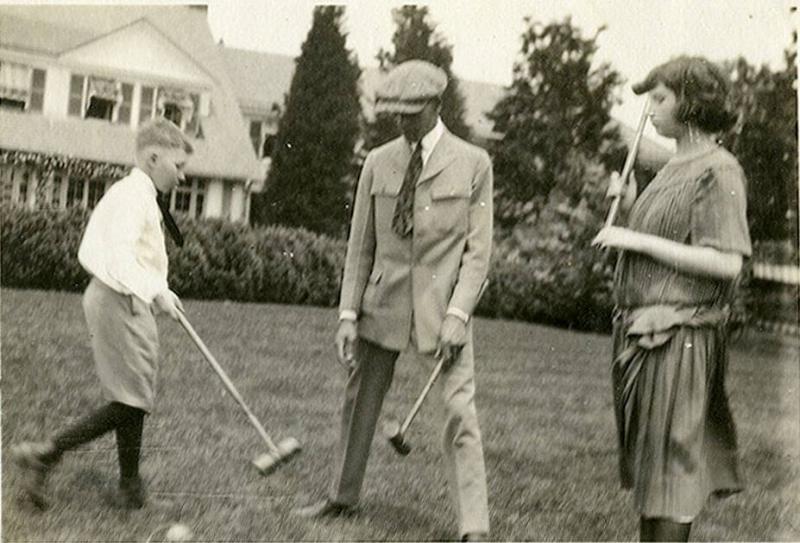
Cleve was well-liked and highly regarded by the Reynolds family. We have an archival photo from 1924 of Cleveland playing croquet with the Reynolds’s youngest son, Smith, and Nancy. The outfit he is wearing is quite dapper, and he looks to be a rather young man. In the fall of 1917, Mrs. Reynolds was having a lengthy stay in Baltimore to be with her ailing husband. In a letter to Katharine, the family governess, Henrietta van den Berg (aka “Bum”), describes a picnic she had organized for the children, saying, “Cleve joined us with lunch, and we made a fire…after which we gathered around the fire and told tales.”
Perhaps more interesting is how well Mrs. Reynolds liked and trusted Cleve. Elizabeth Wade, Katharine’s maid and later switchboard operator, explained that Mrs. Reynolds was “very fond” of Cleve. In fact, no one else drove her but him. Apparently, Mrs. Reynolds also tended to be quite lenient with Cleve if he showed up late for a job, which confounded many of the other staff. Most surprising is that she even paid off his overdue bills from Mock, Bagby, and Stockton, a men’s fine clothing store that later became Norman Stockton.
The year after Mrs. Reynolds Johnston died, Cleve began a new venture, opening Lincoln Barber Shop on North Church Street. The Williams family is recorded as living in Reynolda Village as late as 1930, but after that, they disappear altogether from the city directories. Automobiles were certainly more than a novelty by then, but when the Babcocks moved into Reynolda in the mid-thirties, it is very likely they drove their own cars.
Cleveland’s sons are buried in the Westlawn Gardens of Memory in Clemmons, NC. Their headstones and obituaries give us some clues as to what may have become of their parents. Both men are described as having lived in New York City for some time. As many Black families in the South migrated to northern cities to seek better opportunities and escape Jim Crow segregation during the 20th century, we can speculate that perhaps the Williams family was part of that movement. After Cleveland Sr. and Minnie passed away, their sons later returned to the area in which they were born.The garages where the fabulous vehicles Cleveland Williams drove and maintained for the Reynolds family are now shops in Reynolda Village, like Gazebo and Half Past Three. Who knows what layers of history remain to be revealed in the ongoing restoration of Reynolda House?